The New Feature In Mysql 5.7
|
Safe Harbor Statement |
|
The following is intended to outline our general product direction. It is intended for information purposes only, and may not be incorporated into any contract. It is not a commitment to deliver any material, code, or functionality, and should not be relied upon in making purchasing decisions. The development, release, and timing of any features or functionality described for Oracle’s products remains at the sole discretion of Oracle. |
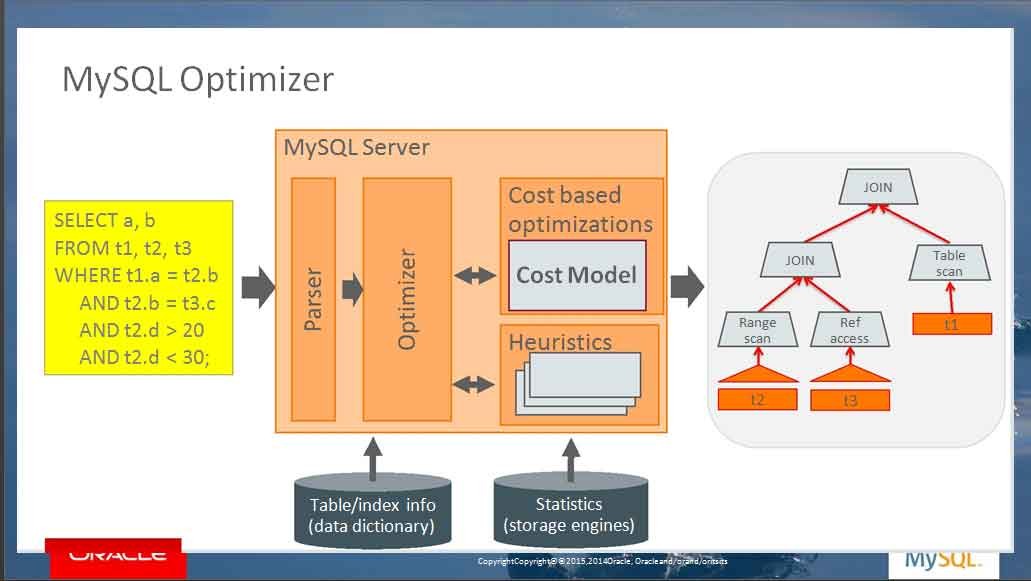
MySQL Optimizer: Design Principles
• Best out of the box performance
• Easy to use, minimum tuning needed
• When you need to understand: explain and trace
• Flexibility through optimizer hints, switches, and plugins
• Fast evolving
MySQL 5.7 Optimizer Improvements
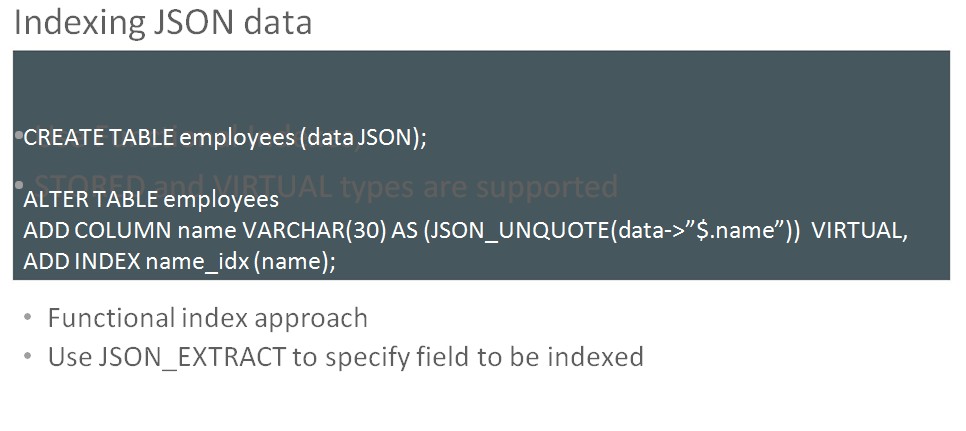
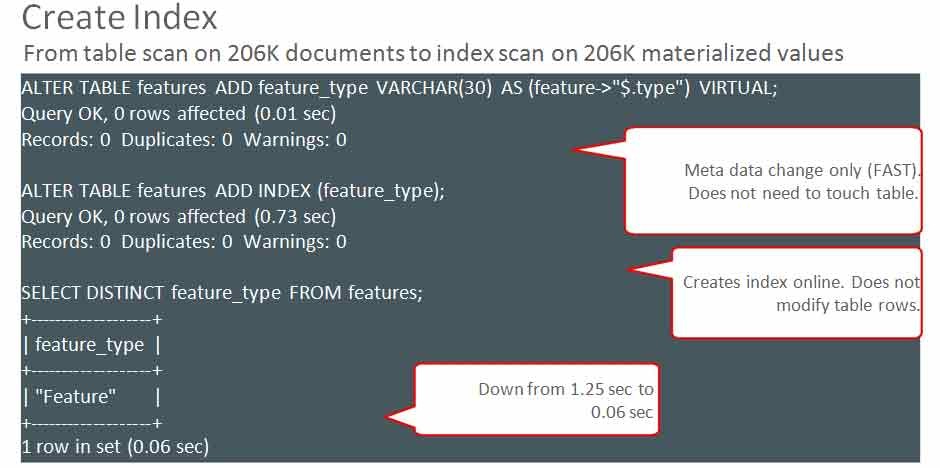
• Generated columns and functional indexes
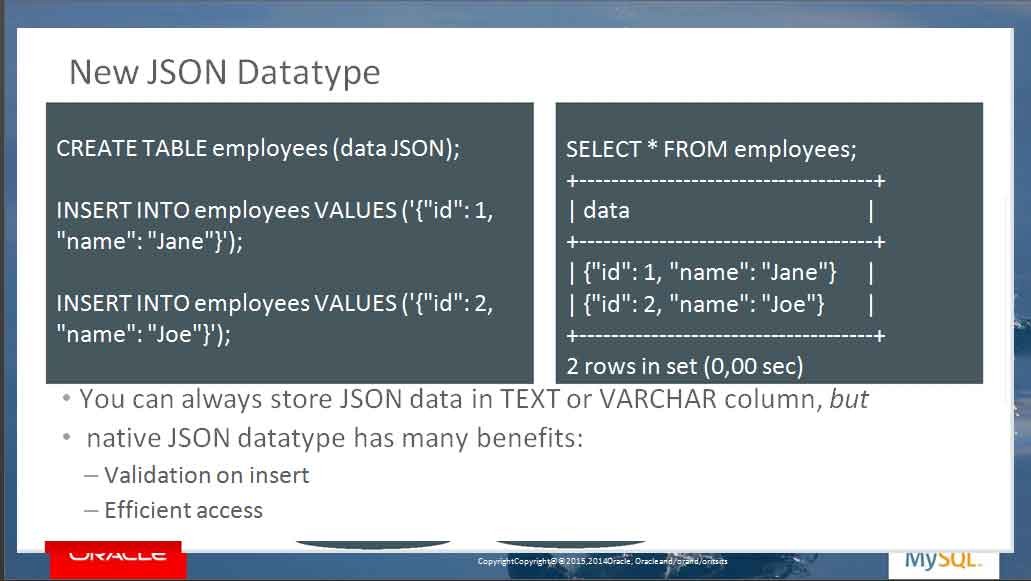
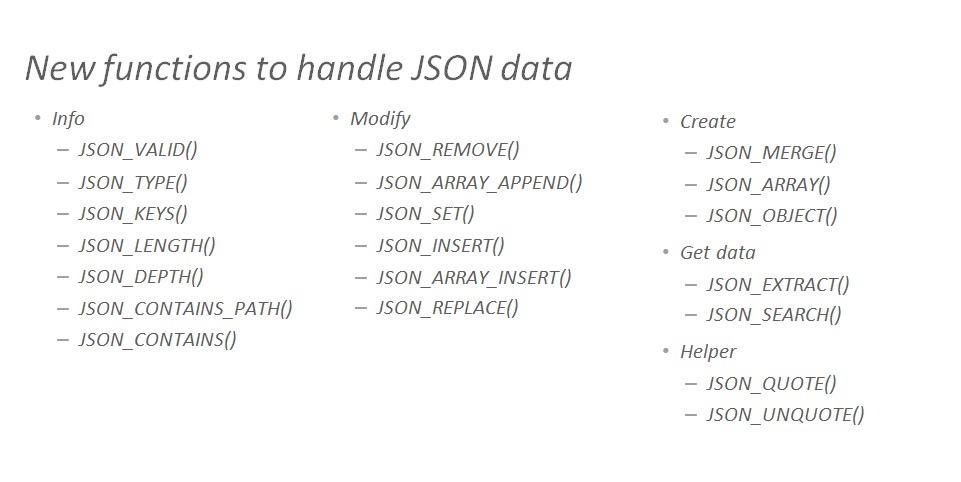
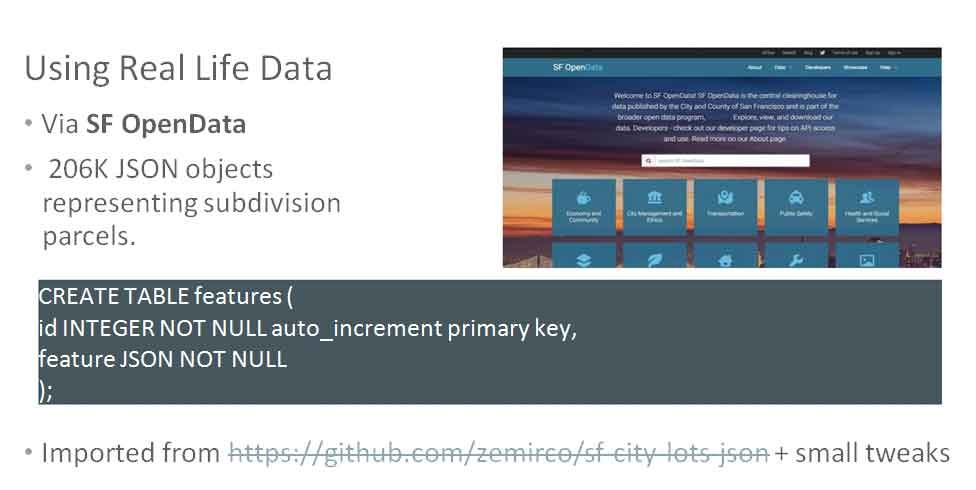
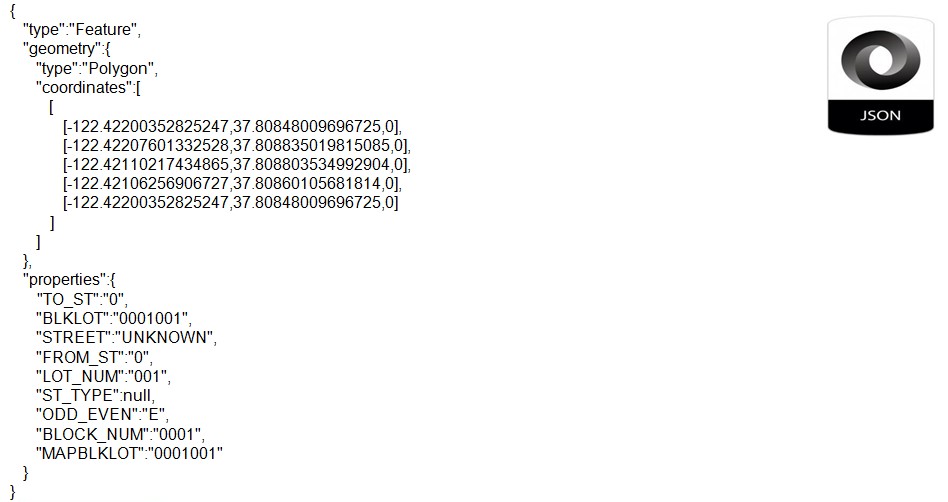
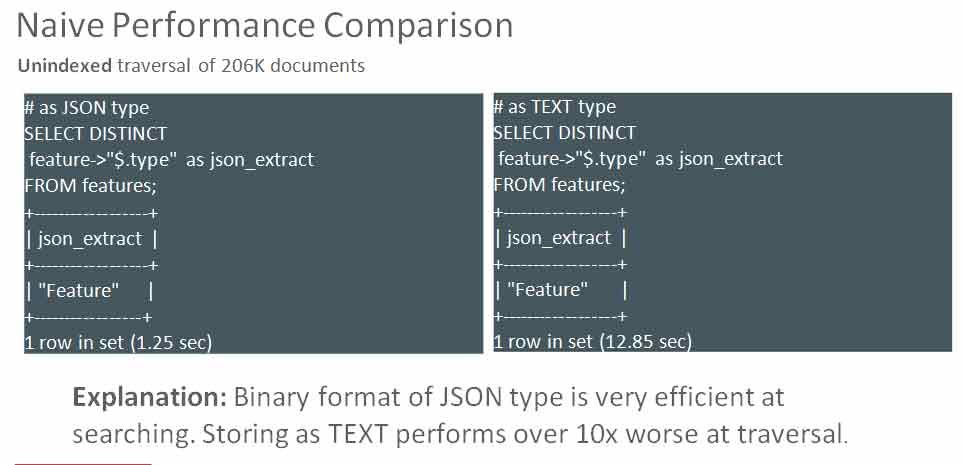
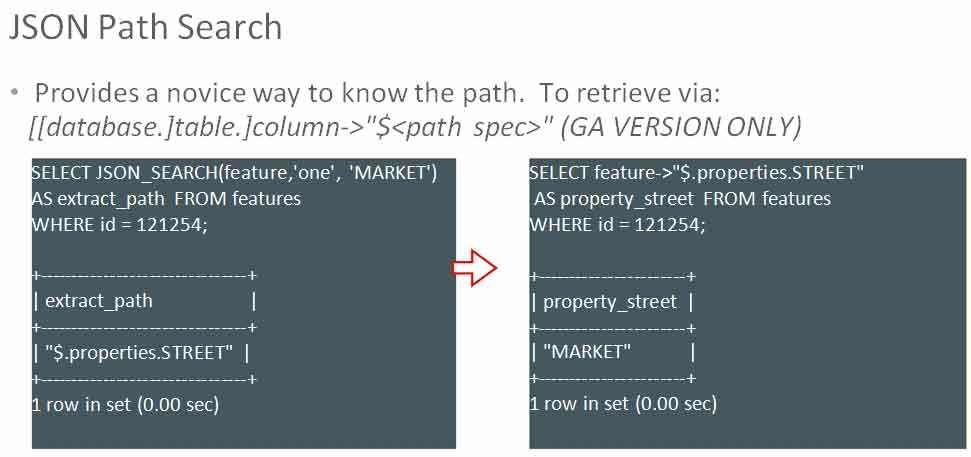
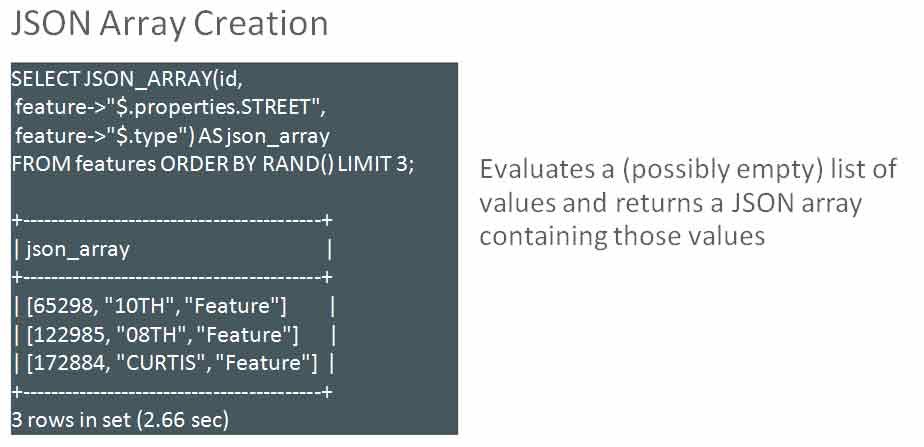
• New JSON datatype and functions
• Improved cost model
• New hint syntax and improved hint support
• Query rewrite plugin
• UNION ALL queries do not always use temporary tables
• Improved optimizations for queries with IN expressions
• Explain on a running query
Indexing Generated column: STORED vs VIRTUAL (InnoDB)
• STORED • VIRTUAL
–Primary & secondary index –Secondary index only
–B-TREE, Full text search, R-TREE –B-TREE only
–Duplication of data in base table –Less storage
and index –Independent of SE
–Online operation –Requires SE support
–Online operation
|
Cost Model: Main Focus in 5.7 |
|
Address the following pain points in current cost model: |
|
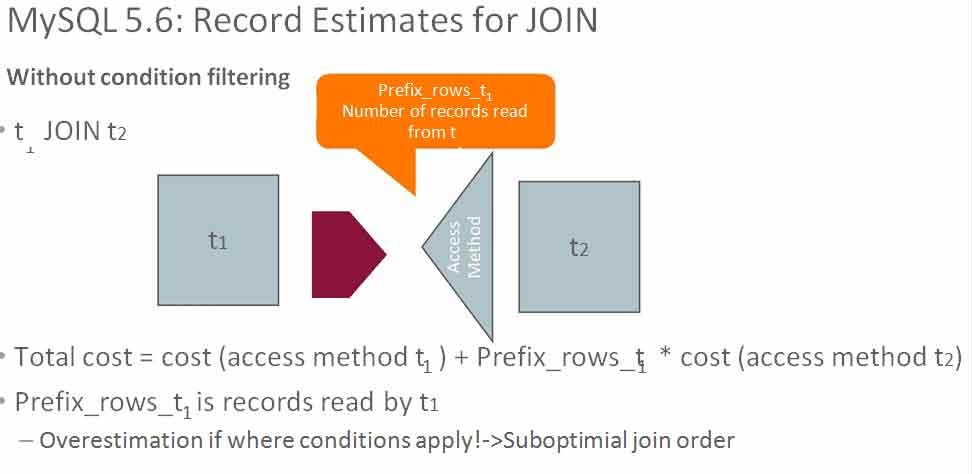
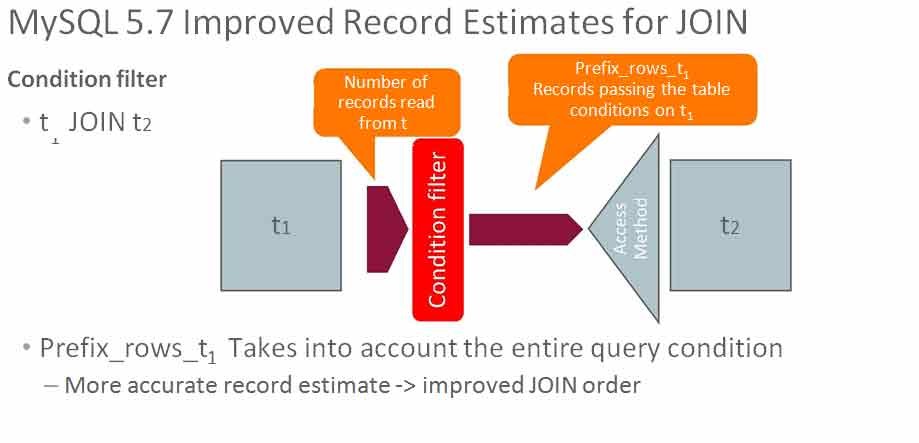
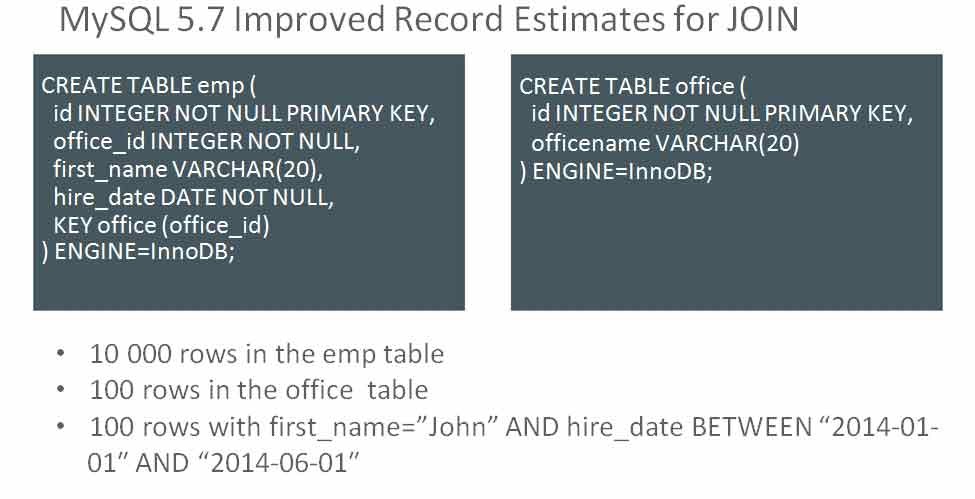
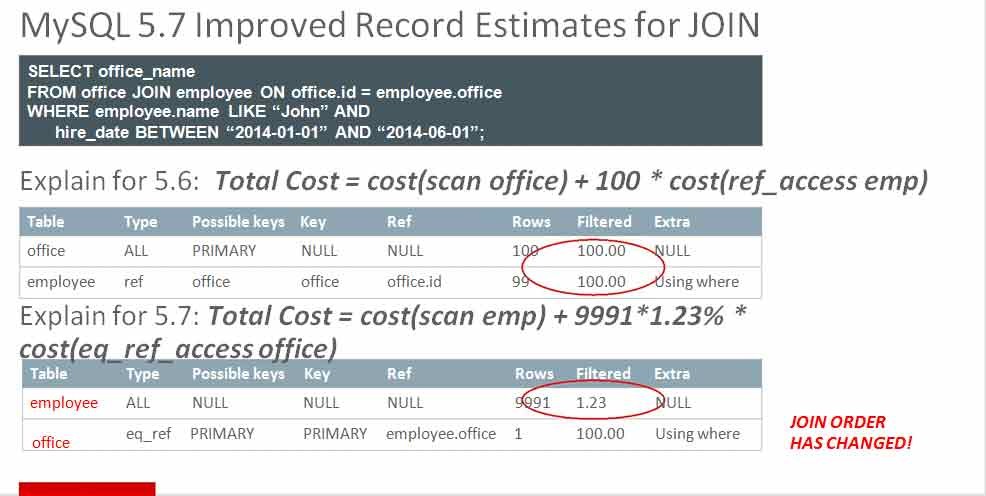
• Inaccurate record estimation for JOIN ØSolution: condition filtering |
|
• Hard-coded cost constants ØSolution: adjustable cost parameters |
|
• Imprecise cardinality/records per key estimates from SE ØSolution: Integer value replaced by floating point |
|
• Hard to obtain detailed cost numbers ØSolution: Added to JSON explain and MySQL WorkBench
MySQL 5.7: Improved HINTs • Introduced new hint syntax /*+ ...*/ – Flexibility over optimizer switch, effect individual statement only – Hints within one statement take preceduence over optimizer switch – Hints apply at different scope levels: global, query block, table, index • Extended hint support – BKA, BNL, MRR, ICP, SEMIJOIN, SUBQUERY,MAX_EXECUTION_TIME++ – Disabling prevents optimizer to use it – Enabling means optimizer is free to use it, but is not forced to use it • Will gradually replace the old hint syntax in upcoming releases 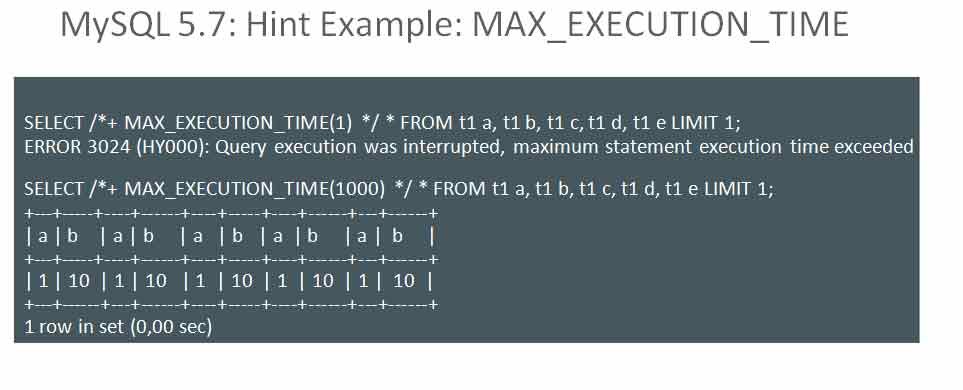 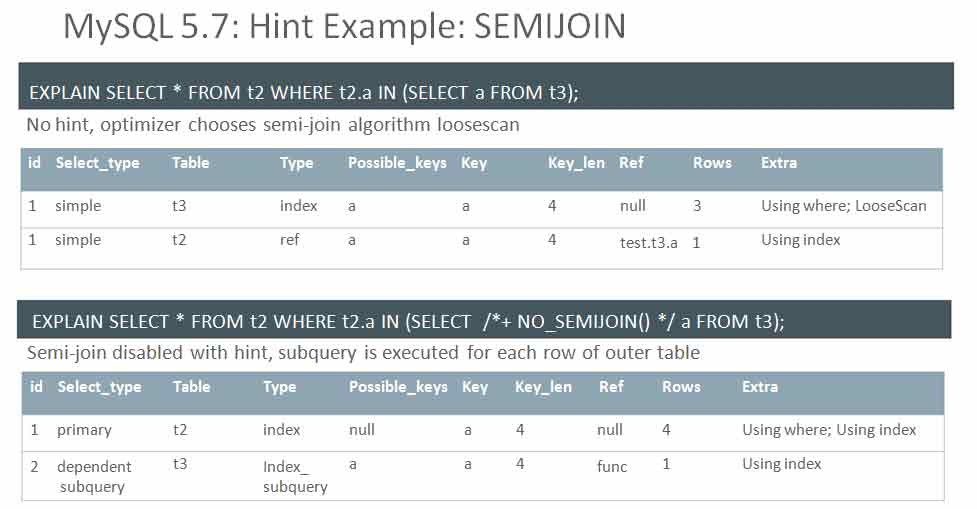 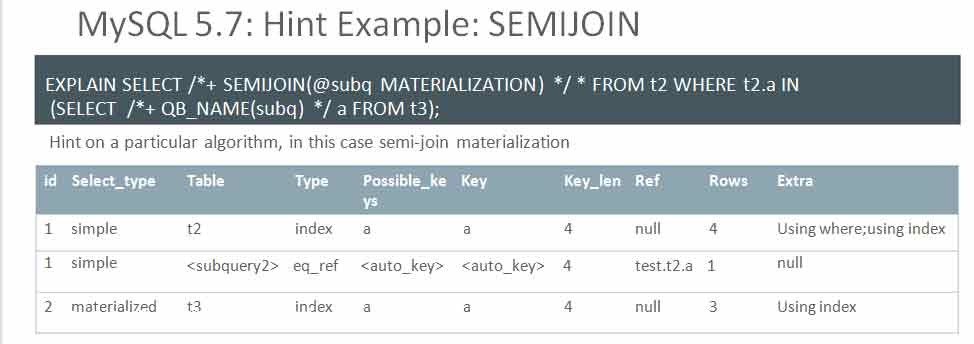 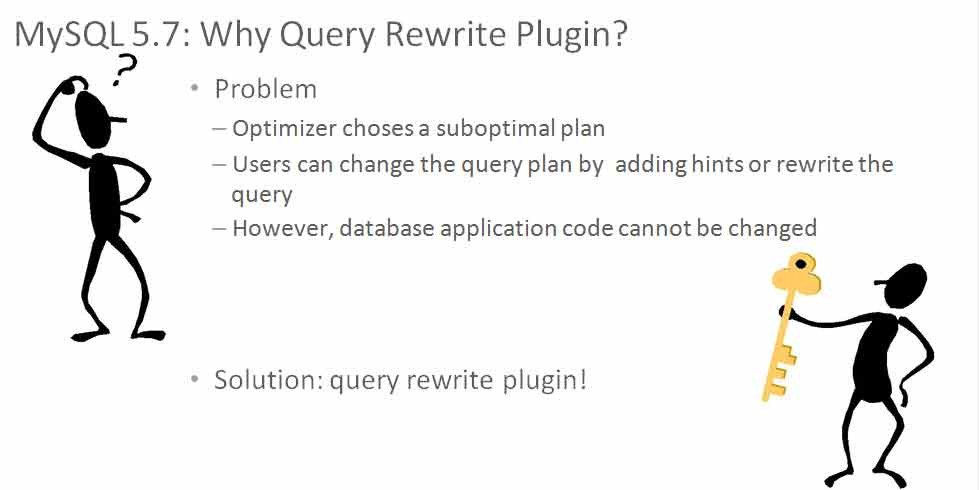 MySQL 5.7: Query Rewrite Plugin • New pre and post parse query rewrite APIs – Users can write their own plug-ins • Provides a post-parse query plugin – Rewrite problematic queries without the need to make application changes • Add hints • Modify join order • Rewrite rules are defined in a table • Improve problematic queries from ORMs, third party apps, etc 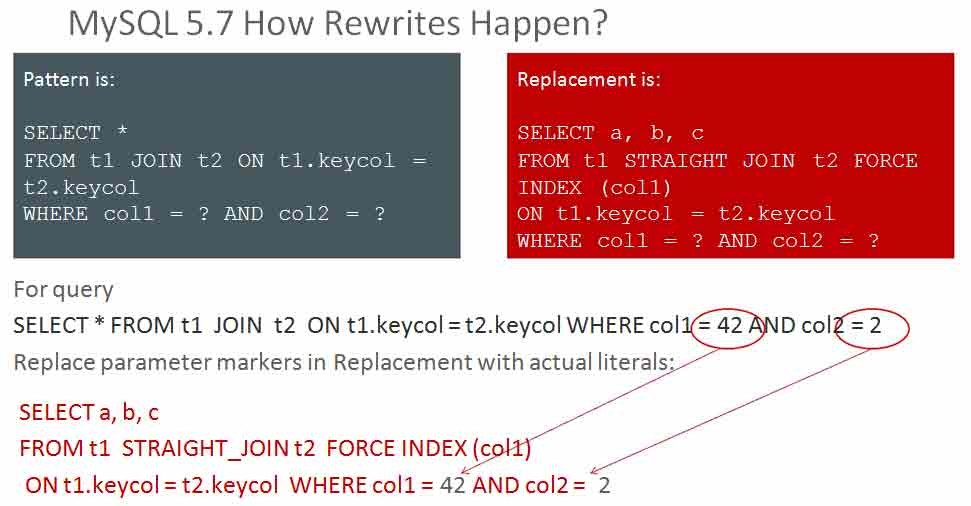 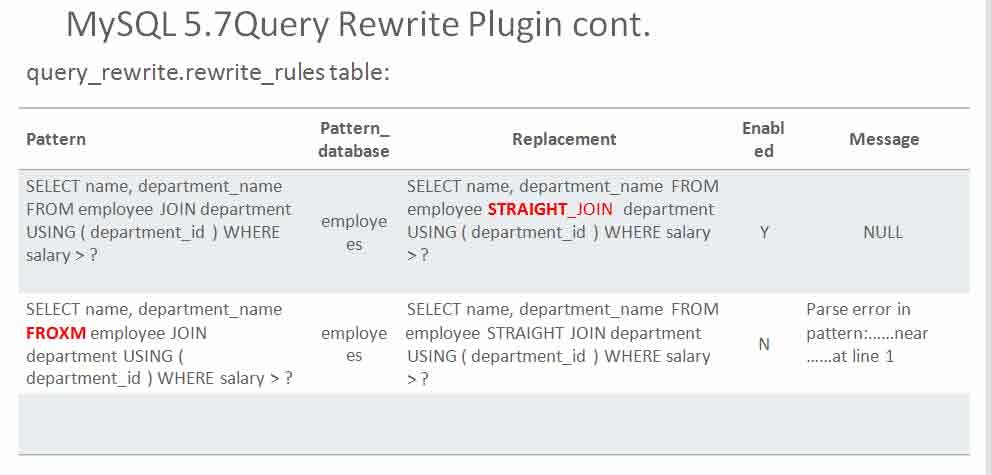 MySQL 5.7 Query Rewrite Plugin: Performance Impact What is the Cost of Rewriting queries? • Designed for rewriting problematic queries only! • ~ Zero cost for queries not to be rewritten – Statement digest computed for performance schema anyway • Cost of queries to be rewritten is insignificant compared to performance gain – Cost of generating query + reparsing max ~5% performance overhead – Performance gain potentially x times MySQL 5.7: Avoid Creating Temporary Table for UNION ALL SELECT * FROM table_a UNION ALL SELECT * FROM table_b; • 5.6: Always materialize results of UNION ALL in temporary tables • 5.7: Do not materialize in temporary tables unless used for sorting, rows are sent directly to client • 5.7: Client will receive the first row faster, no need to wait until the last query block is finished • 5.7: Less memory and disk consumption MySQL 5.7: Optimizations for IN Expressions CREATE TABLE t1 (a INT, b INT, c INT, KEY x(a, b)); SELECT a, b FROM t1 WHERE (a, b) IN ((0, 0), (1, 1)); • 5.6: Certain queries with IN predicates can’t use index scans or range scans even though all the columns in the query are indexed. • 5.6: Range optimizer ignores lists of rows • 5.6: Needs to rewrite to de-normalized form SELECT a, b FROM t1 WHERE ( a = 0 AND b = 0 ) OR ( a = 1 AND b = 1 ) • 5.7: IN queries with row value expressions executed using range scans. • 5.7: Explain output: Index/table scans change to range scans 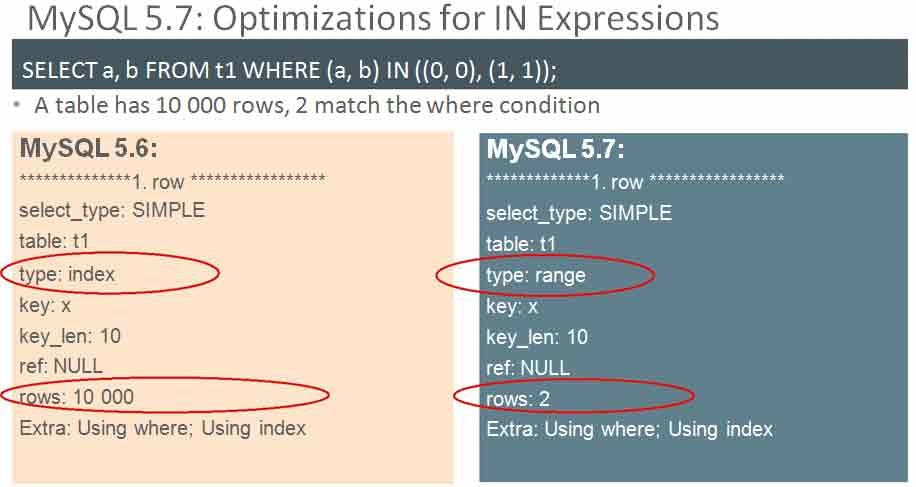 |
- 发表于 2016-08-22 22:46
- 阅读 ( 66 )


